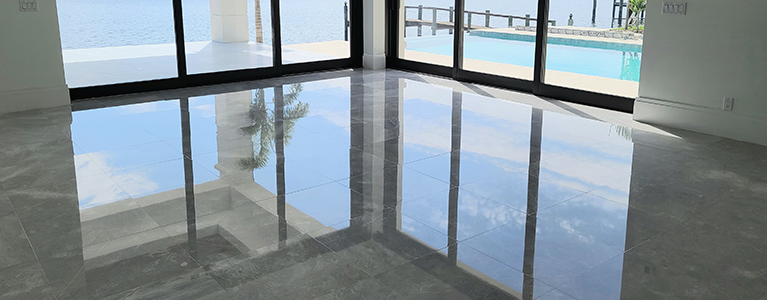
How Salt Air and Moisture Destroy Marble on Yachts and Waterfront Properties (And What to Do About It)
You spent serious money on your yacht or waterfront property. The marble surfaces are part of what makes it feel like the investment it is. But in South Florida, whether your marble is aboard a yacht, inside a waterfront condominium, or throughout a luxury coastal residence, it is constantly exposed to one of the harshest environments on the planet.
Salt air and humidity don’t wait for an invitation. They get in immediately, and the damage they cause is cumulative. By the time it’s visible, it’s already been going on for a while.
Marble Is More Vulnerable Than You Think
Most people assume marble is tough. It looks tough. In reality, it’s calcium carbonate, which means it reacts chemically to acids. And salt air, especially the kind that settles in marine environments, creates the conditions for exactly that kind of reaction.
Here’s what’s actually happening. Salt particles from ocean spray land on marble surfaces, sit there, and pull moisture from the humid air. Over time, this creates a residue that traps contaminants and moisture against the stone, contributing to surface deterioration, discoloration, and accelerated wear. Etching isn’t a scratch or a stain. It’s a chemical change to the surface itself. It shows up as dull spots, white marks, or a hazy appearance that won’t wipe clean.
Once the surface is etched, it becomes more susceptible to everything else.
What the Marine Environment Does to Marble on Yachts and Waterfront Properties
While yachts face direct exposure to ocean spray, waterfront homes and condominiums experience many of the same challenges from airborne salt, humidity, and constant coastal moisture.
High humidity keeps stone surfaces perpetually damp. That moisture works into the pores of the marble and, over time, causes discoloration from the inside out. If organic material gets in alongside the moisture, mold and mildew growth beneath the surface becomes a real possibility.
UV exposure accelerates the breakdown of any protective sealant. Sealant that might last two years in an interior application wears out significantly faster on a yacht or waterfront property exposed to direct sunlight.
Vibration from yacht engines can create microscopic stress within stone surfaces over time. While these changes are often not visible, they can contribute to long-term wear and create pathways for moisture and contaminants.
Waterfront properties face their own challenges from constant exposure to airborne salt, coastal moisture, and humid conditions year-round. That combination of salt air, humidity, UV exposure, vibration, and constant coastal moisture creates challenges that most standard stone care guidance simply doesn’t address.
The Signs Most Owners Miss
The obvious signs are etching and staining. But there are subtler things worth watching for.
If marble floors feel slightly gritty after cleaning, salt residue is building up in the pores. If the stone looks clean but has lost its reflectivity, surface etching has already occurred. If there’s any darkening around the edges of slabs or near seams, moisture has gotten in.
None of this is irreversible. But the longer it goes unaddressed, the deeper the damage goes and the more involved the restoration process becomes.
What Actually Works
Cleaning matters, but cleaning alone won’t protect marble on a yacht or in a waterfront property. Protection requires thinking in three layers.
The surface has to be properly sealed, and that seal needs refreshing more frequently than most people realize in a marine environment. Standard guidance for interior marble sealing runs anywhere from one to three years. On yachts and coastal properties exposed to salt air and direct sunlight, that timeline compresses significantly.
When etching has already occurred, it can’t be cleaned away. The stone has to be professionally honed or polished to remove the damaged layer and restore the surface. Attempting to handle this with the wrong products usually makes it worse.
And if moisture damage has gotten deep, the restoration process requires someone who understands how marble behaves, not a general cleaning crew treating it as a surface rather than a material with specific chemistry.
When to Call in a Professional
Salt and moisture damage that’s already visible has been building for a while. If you’re seeing dull spots, white haze, dark patches near seams, or a surface that won’t look clean no matter what you do, cleaning alone won’t fix it.
At Just Call Classic, we’ve been restoring natural stone aboard yachts and throughout luxury waterfront properties since 1997. We understand that marine environments are a different challenge entirely. The products, the approach, and the logistics of working on yachts and luxury waterfront properties require experience that general stone care companies often don’t have.
We serve yachts, waterfront residences, condominiums, and luxury commercial properties throughout Broward, Miami-Dade, and Palm Beach counties. If your marble surfaces are showing signs of salt air or moisture damage, don’t wait until the deterioration becomes more extensive.
Call us today at (954) 578-3600 for a free consultation.